Microsoft 365 Service
Table of Contents
- Prerequisites
- Setting up with the one-click service (recommended)
- Setting up with manual DNS configuration
- Verifying your domain with Microsoft
- Configuring email authentication
- Troubleshooting
- Have more questions?
Microsoft 365 (formerly Office 365) provides professional email hosting with Outlook, along with Office applications and collaboration tools. You can configure the required DNS records in DNSimple using the one-click service or by adding records manually.
Prerequisites
Before configuring Microsoft 365 DNS in DNSimple:
- You need an active Microsoft 365 subscription.
- Your domain must be in your DNSimple account with a primary (forward) zone.
- Complete the initial Microsoft 365 domain setup and note the TXT and MX records Microsoft provides.
Warning
If you are currently using DNSimple email forwarding, you must disable it before setting up Microsoft 365. Email forwarding and email hosting cannot be used simultaneously because both rely on MX records.
Setting up with the one-click service (recommended)
Add Microsoft 365 with the one-click service
- From the domain list, click on the domain name you want to update.
- Click the tab on the left side.
- Scroll down to the card, and click .
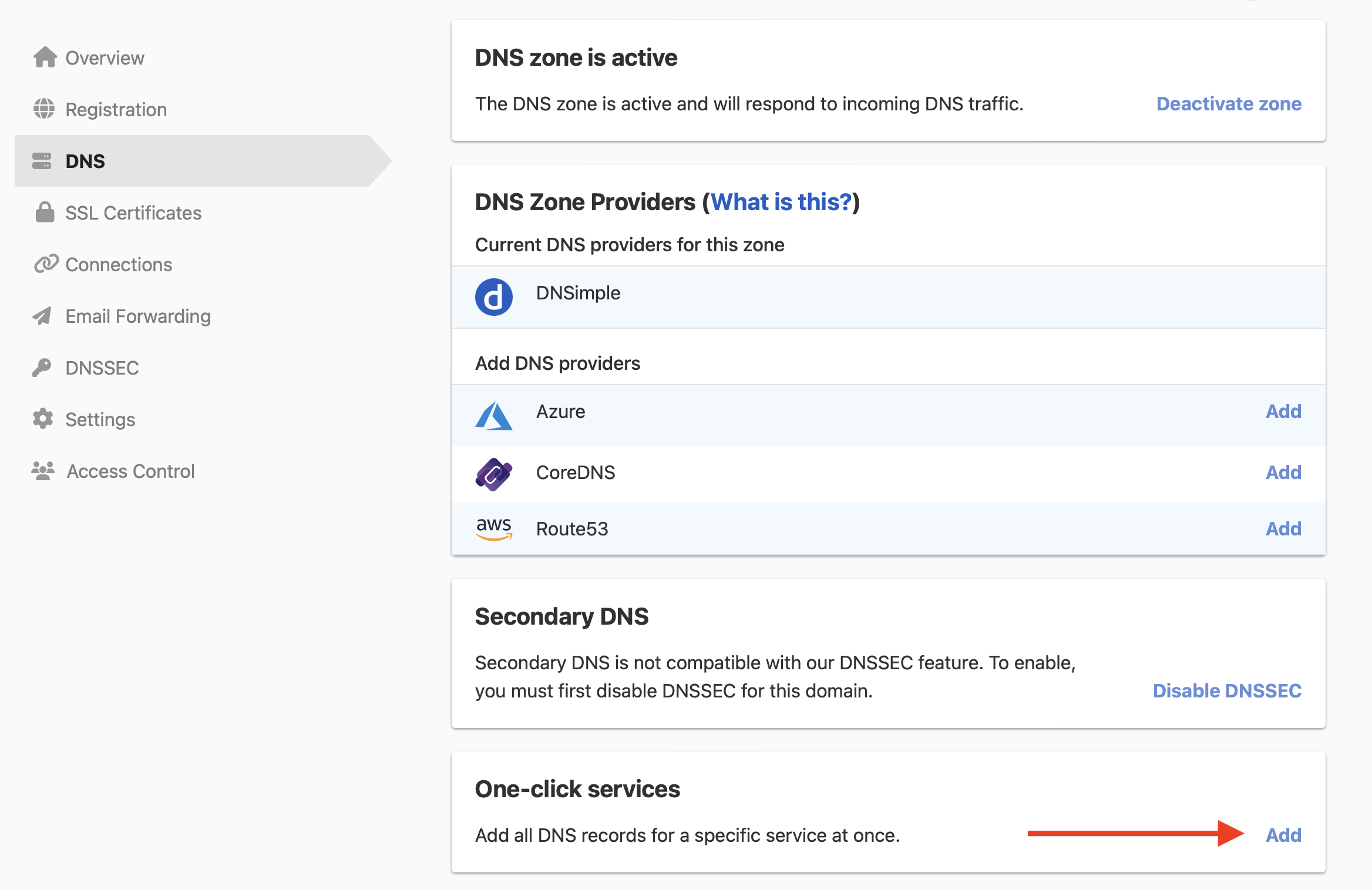
- Select the tab, and scroll down to the Office 365 service. Click .

- Enter the TXT and MX records provided by Microsoft, then click .
The one-click service automatically configures MX records and other required DNS records. You can remove it any time by following the steps in how to remove a service.
Setting up with manual DNS configuration
If you prefer to configure DNS records manually:
-
Get the required DNS records from the Microsoft 365 admin center under > > your domain > .
-
Microsoft typically provides an MX record like:
| Priority | Mail Server |
|---|---|
| 0 | yourdomain-com.mail.protection.outlook.com |
Add MX records manually
- Navigate to your domain’s tab and open the .
- Remove any existing MX records if you are switching from email forwarding or another provider.
- Click and select MX.
- Leave the field blank (or enter
@) for the root domain. - Enter the priority value from Microsoft (typically 0).
- Enter the mail server hostname from Microsoft.
- Click .
Microsoft may also require additional records:
- TXT record for domain verification
-
CNAME record for Autodiscover (
autodiscoverpointing toautodiscover.outlook.com) - Additional CNAME or TXT records for other Microsoft 365 services
Add these records as provided by the Microsoft 365 admin center.
Verifying your domain with Microsoft
Microsoft requires domain verification to activate Microsoft 365. After adding the DNS records:
- In the Microsoft 365 admin center, go to > and select your domain.
- Click . Microsoft will check for the verification TXT record. This typically completes within a few hours.
Configuring email authentication
For better email deliverability, set up SPF, DKIM, and DMARC for your domain.
SPF: Your SPF record should include include:spf.protection.outlook.com. See What Is an SPF Record? for details.
DKIM: Enable DKIM in the Microsoft 365 admin center under > > your domain > . Microsoft provides two DKIM selectors (selector1 and selector2) with corresponding CNAME or TXT records to add in DNSimple. See Set Up DKIM for instructions.
DMARC: Add a DMARC record to monitor and protect against spoofing. See Set Up DMARC for instructions.
Troubleshooting
Emails not being delivered: Verify MX records are correctly configured with dig +short yourdomain.com MX. Check whatsmydns.net for propagation status. Ensure no conflicting MX records or email forwarding is still active.
Domain verification failing: Confirm the TXT verification record matches exactly what Microsoft provided. DNS changes can take up to a few hours to propagate.
Autodiscover not working: Verify the autodiscover CNAME record points to autodiscover.outlook.com. If automatic configuration fails, configure email clients manually using Microsoft’s server settings.
Email authentication failures: Verify your SPF record includes include:spf.protection.outlook.com. Check DKIM records are at the correct subdomains. For setup details, see SPF records, Set Up DKIM, and Set Up DMARC.
Have more questions?
If you have additional questions or need any assistance setting up Microsoft 365 with DNSimple, just contact support, and we’ll be happy to help. You can also read more about DNSimple integrations.